


From the Safety Brake to Regenerative Drives: Managing Energy in Modern Lift Systems
Downloads
| REO2026-20-Robust-Braking-Resistors-for-Lift-and-Escalator-Systems.docx ( DOCX 239KB) |
| REO2026-03.png ( PNG 440KB) |
Today, lift engineering is concerned not only with moving people safely, but with doing so efficiently and managing the electrical energy involved
The lift has changed considerably since Elisha Otis demonstrated his famous safety brake in New York in 1854. By preventing a lift platform from falling if its supporting rope failed, the invention helped make passenger lifts practical. It ultimately enabled buildings to grow upwards rather than outwards, and the first Otis passenger elevator followed in 1857.
Today, lift engineering is concerned not only with moving people safely, but with doing so efficiently and managing the electrical energy involved.
A striking example familiar to many visitors to Berlin is the Berlin TV Tower. Its lifts travel at around 6 metres per second, carrying visitors to the observation deck some 203 metres above Berlin in approximately 35 seconds. It is a useful reminder of just how much engineering sits behind something most of us use without a second thought.
Modern lift systems increasingly combine regenerative drives with Uninterruptible Power Supply (UPS) backup to provide an economical, energy-efficient and electrically safe solution.
During certain movements — for example, a heavily loaded car travelling downwards or a lightly loaded car travelling upwards — the lift motor can operate as a generator. Under normal mains conditions, the lift can use that regenerated energy elsewhere in the building or return it to the electrical supply.
The challenge arises when the mains supply fails, and the lift is used in conjunction with a UPS.
Many UPS systems are not designed to accept significant reverse power flow. If the regenerative energy has nowhere to go, system voltage can rise and potentially cause the drive or UPS to shut down to protect itself.
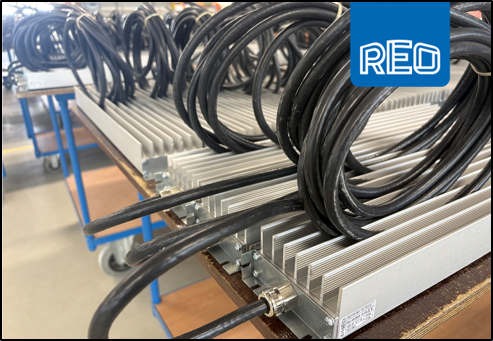
This is where a REO load resistor or resistor bank becomes an important part of the system.
When required, the resistor bank switches into the circuit to provide a controlled electrical load, safely converting regenerated electrical energy into heat. When mains power is available, it remains inactive, allowing the regenerative drive to retain its efficiency benefits.
Correct selection involves considerably more than resistance and nominal power. Peak regenerative power, energy in joules, braking duration, duty cycle, frequency of operation, cooling and temperature monitoring all need to be considered.
More than 170 years after lift safety helped transform our cities, the engineering principles continue to evolve. In a regenerative lift system, the REO resistor provides a comparatively simple component with an important job: giving regenerative energy a safe place to go when the grid cannot take it.