


When Replacing a Failed Fan Motor Isnt Enough
Downloads
| REO2026-22-When-Replacing-a-Failed-Fan-Motor-Isnt-Enough.docx ( DOCX 240KB) |
| REO2026-22.png ( PNG 1539KB) |
When Replacing a Failed Fan Motor Isnt Enough
Repeated motor failures in variable-speed HVAC installations can indicate an underlying electrical problem that replacing the motor alone will not resolve.
Variable-speed drives (VSDs) have transformed modern HVAC systems, offering precise control of fans, pumps and ventilation equipment while helping reduce energy consumption. However, they can introduce electrical stresses that require careful consideration, particularly when connected motors are located a considerable distance from their drives.
Experience has highlighted an interesting trend: enquiries for sine wave filters are sometimes triggered by reports of premature fan motor failures. Rather than being specified when an installation is first commissioned, the filter is considered retrospectively as engineers investigate potential causes of motor damage.
A variable-speed drive does not produce a conventional sinusoidal supply. Instead, the inverter uses rapidly switched voltage pulses to control motor speed. These pulses create high rates of voltage change (dV/dt) and can produce significant voltage peaks at the motor terminals. Long motor cables can worsen the problem through reflected-wave effects, increasing the electrical stress on motor winding insulation. Where these effects contribute to insulation deterioration, replacing the motor without addressing the electrical conditions will almost certainly expose the replacement to similar stresses.
A properly specified sinewave filter installed between the inverter and motor substantially smooths the drive’s output waveform, reducing high-frequency components, voltage stress and audible noise.
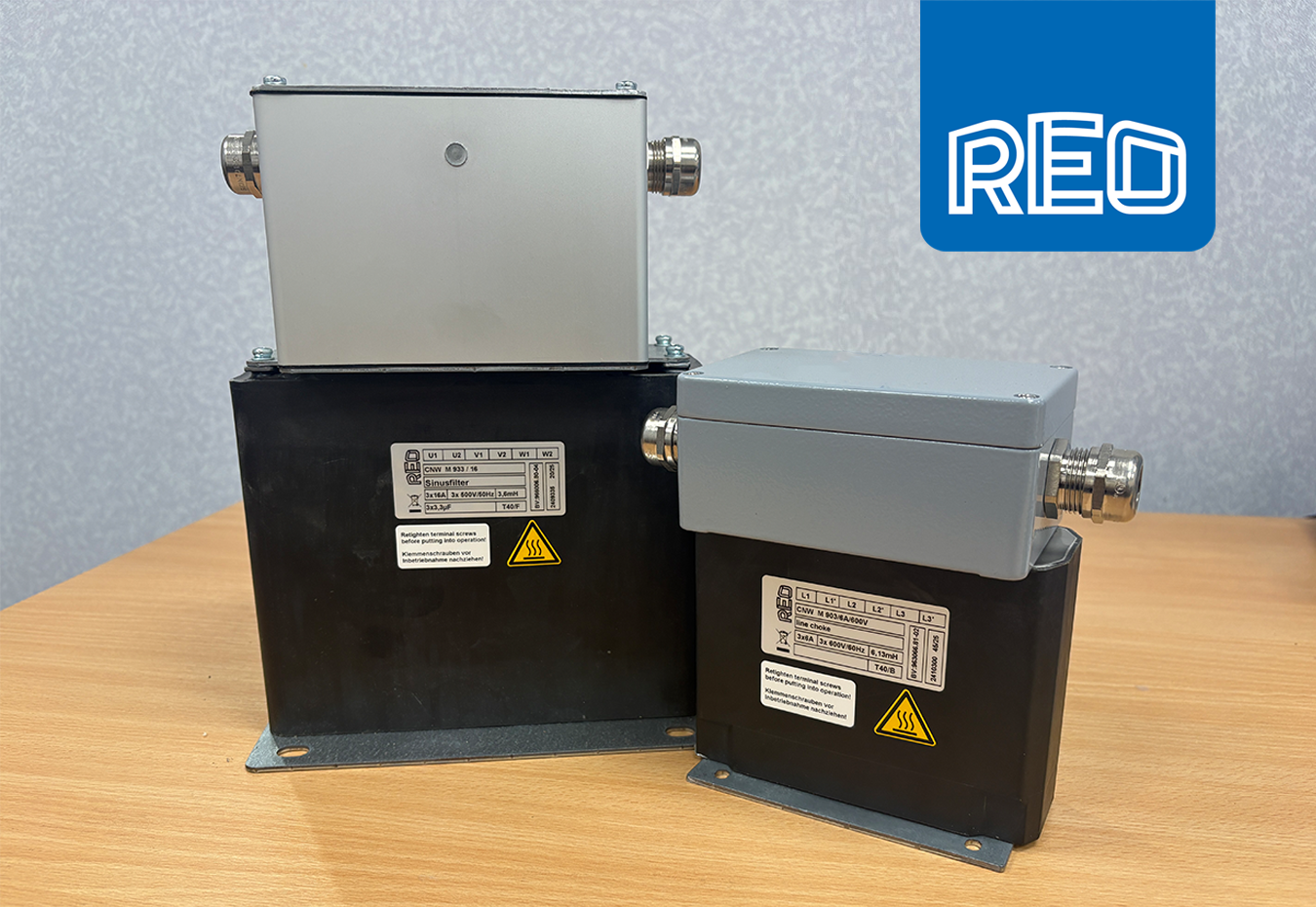
The REO CNW M 933 range provides sinewave filtering in a compact, encapsulated configuration. In applications using the IP65 version, the filter offers a practical retrofit advantage: unlike an IP00 product, which generally needs a suitable protective enclosure, an appropriately installed IP65 unit can be mounted outside an existing electrical cabinet and can even be used in washdown environments.
This can be valuable where cabinet space is limited, or a separate enclosure would be difficult to accommodate. Compact construction and straightforward connections may also simplify installation in existing HVAC plantrooms and similar industrial environments.
Not every motor failure is caused by inverter switching; bearings, overheating, contamination, mechanical resonance and loading must also be investigated. However, where inverter-related voltage stress is confirmed, fitting a suitable sine wave filter can help protect the replacement motor.
For maintenance engineers, the objective is straightforward: identify the reason for failure, address the underlying problem and reduce the likelihood of it happening again.