


Brake Resistors – Dangers of Poor Design

Downloads
| REO2025-32-Brake-Resistors-Dangers-of-Poor-Design.docx ( DOCX 242KB) |
| Figure-1-2-scaled.png ( PNG 6137KB) |
| Figure-2-scaled.jpg ( JPG 695KB) |
When Brake Resistors Fail – The Dangers of Poor Design
Braking resistors are often treated as low-cost consumables – simple components that “just burn off energy.” In reality, they are a safety-critical part of any drive system. Once they fail, the entire drive is at risk.
REO was recently asked to assist a customer who had suffered multiple failures in their braking resistor assemblies. The original units, supplied by another manufacturer, were operating in a demanding environment with constant vibration, temperature variations, and airborne moisture.
Even though the enclosures were zinc passivated, some minor corrosion was evident on the casing, See Figure 1, and some discolouration was observed around the terminals, but these early warning signs developed into something far more serious. Several resistor units eventually failed, causing the entire drive system to trip and, in one case, to fail catastrophically.
Upon investigation, the failed resistors showed a combination of mechanical and thermal damage. The ceramic wire guides, known as formers, had fractured, most likely due to continuous shock and vibration, which weakened their structure over time. Once the ceramic support was compromised, the wound resistance wire was no longer positioned correctly, creating localised hot spots, uneven heat distribution, and also increasing the likelihood of dangerous short-circuit conditions.
We also suspect that the units were less thermally efficient than their REO equivalents – meaning heat could not dissipate as quickly, leading to higher internal temperatures during braking cycles. Under normal circumstances, the built-in protection should have interrupted operation before those temperatures reached dangerous levels; however, that safeguard failed as well.
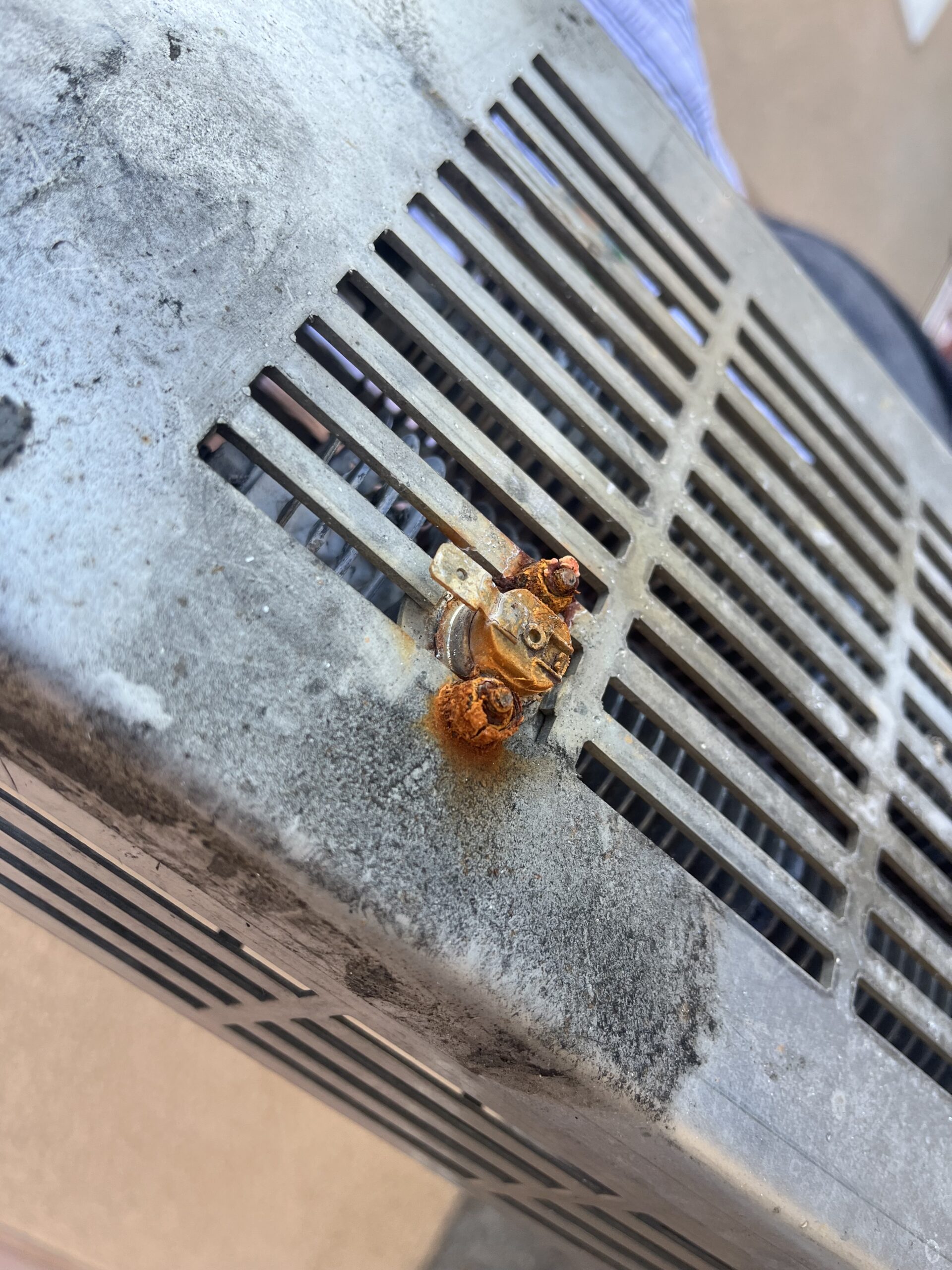
Each resistor was fitted with a bimetallic thermal switch, designed to trip when the resistor’s surface temperature exceeded a safe threshold. In principle, this is a simple and effective safety mechanism. The switch uses two metals bonded together, each of which expands at a slightly different rate when heated. As the temperature rises, the metal strip bends, activating a contact that opens the circuit and signals the drive to limit braking power.
In this case, however, the switches had become heavily corroded, likely due to moisture ingress and exposure to the elements – see figure 2. Once corrosion sets in, the contacts can stop functioning correctly, meaning they either trip too late or not at all. when that happens, the resistor remains exposed to braking energy long after it should have been isolated. With the resistor already running hotter than intended and the protective switch no longer working, the outcome was inevitable: runaway heating of the resistor, which eventually led to the units catching fire in some cases.
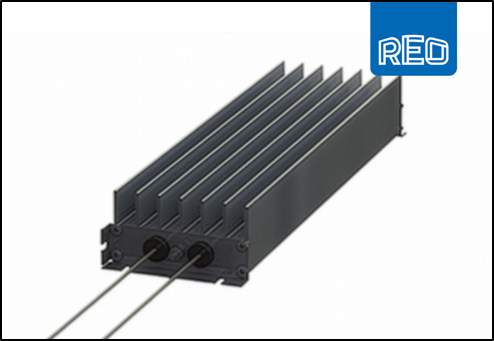
When REO was called in, it was clear that the customer didn’t just need new resistors – they needed a design that could withstand the same conditions without degradation. We supplied units from our BW156 range, chosen specifically for their mechanical strength, thermal efficiency, and environmental protection.
Compared to conventional tubular or Grid-style resistors, the BW156 range is engineered for long-term durability in industrial and transport applications:
- A corrosion-resistant alloy housing provides robust protection against moisture, salt mist, and airborne contaminants.
- Vibration-resistant structural integrity under constant mechanical stress, preventing wire movement or cracking.
- Optimised finned design improves heat dissipation, keeping operating costs lower and extending service life.
- Internally mounted thermal switches can be embedded within the resistor body itself and sealed to IP65, isolating from dust, dirt, and moisture ingress, eliminating any issues with corrosion.
This last feature is significant, by protecting the temperature sensor inside the housing rather than leaving it exposed, REO eliminates the single most common point of failure in the appliaction. Even in humid or coastal environments, the sensor continues to operate reliably and trips precisely at it rated temperature.
To validate this design, REO demonstrated test results showing the shock and vibration resistance of the BW156 construction, along with salt-mist resilience, confirming the long-term corrosion protection of the housings and fixings.
In addition, the customer was shown comparative thermal data highlighting how the BW156 dissipated heat more effectively than traditional grid or tubular resistors. By maintaining lower surface and internal temperatures under equivalent load conditions, REO’s design significantly reduces stress on materials and extends operational life. After installation, the customer reported stable and reliable operation under the same conditions that had previously caused repeated failures. The sealed IP65 thermal switches now function exactly as intended, and no signs of overheating or corrosion have been observed.
If they fail, the entire drive is at risk, not to mention the process and application as well as the cost and time in resolving the issue.
REO’s BW156 range demonstrates how intelligent design – from internal heat flow to protective sealing – makes the difference between predictable, safe operation and catastrophic fauilure. With performance under vibration, salt mist, and temperature cycling externally validated, the BW156 gives engineers confidence that when a system is put under stress, the resistor wont be the weak link.
For more information, please visit https://www.reo.co.uk/brake-resistors/